Dame Elizabeth Violet Blackadder RSA: Newhall Mains
viewing_room
Elizabeth Blackadder is one of the most celebrated Scottish artists of the twentieth century. Her paintings, drawings and prints predominantly portray landscapes encountered during her travels, or still life arrangements of objects and textiles. However, she is perhaps best known for her charming depictions of flowers and cats.
Blackadder was born in Falkirk, to the west of Edinburgh, in 1931. She attended Edinburgh College of Art between 1949-1954, and later returned to the college as a painting tutor. She and her husband, the artist John Houston, were devoted travellers, and cultivated a particular affection for Japan and Venice. Blackadder enjoyed a distinguished artistic career and was the first woman to be elected to both the Royal Academy and the Royal Scottish Academy. In 2000 she was named Her Majesty’s Painter and Limner in Scotland, and in 2011 the National Galleries of Scotland held a major retrospective exhibition of her work.
This exhibition showcases a selection of Blackadder’s prints of floral and Japanese subjects. From 1985, she regularly collaborated with the master-printers at Glasgow Print Studio. Her preferred techniques were etching, which allowed her to showcase her characterful draughtsmanship, and screenprinting, which produced inky hues of vibrant intensity.
£2,800.00 (unframed)
£3,000.00 (framed)
Blackadder’s interest in floral arrangements began during her childhood, which she recalled was often spent engaged in solitary activity. At around the age of ten, a favoured pastime was the collection of flowers local to her hometown of Falkirk, which she would press, compile into albums, and label with their Latin names.
£1,500.00 (unframed)
£1,650.00 (framed)
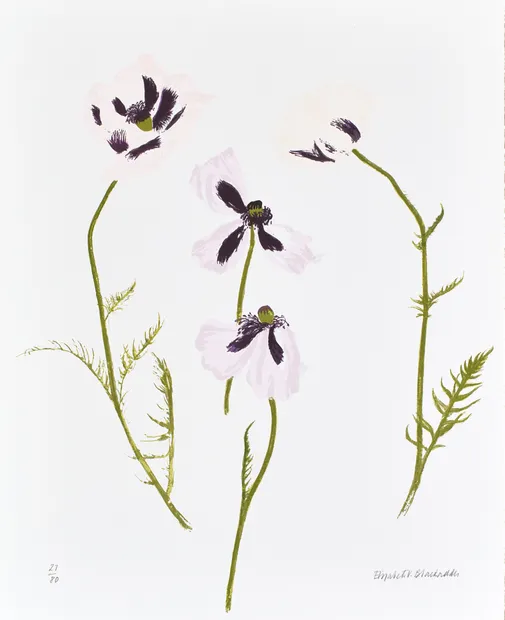
To make a screenprint, an image must be built up by printing each colour in a separate layer. It produces rich, vivid hues, but challenges the artist to use only a limited tonal palette. Four Poppies implements light and dark layers of purple and green ink, which Blackadder has meticulously layered to evoke the delicate petals and stems.
£1,500.00 (unframed)
£1,650.00 (framed)
Art historian Duncan Macmillan reflected that Blackadder’s ‘respect for the individual nature of a flower led her to give an account of its appearance thorough enough to satisfy the demands of any botanist, but though she rarely strayed far in the direction of expressionism, nevertheless her flower paintings are also very clearly art, not scientific analyses… she observed and recorded them all in a way that was unique in its combination of sharp observation with manifest sympathy - a kind of imaginative projection in which, because of her skilful execution, we can share.’ (Macmillan, D., The Art of Elizabeth Blackadder, Lund Humphries, London, 2023, p.9)
£1,450.00 (unframed)
£1,570.00 (framed)
In 1985, when Blackadder commenced her collaboration with Glasgow Print Studio, the first technique she adopted was etching. This entailed using a needle to incise an image onto a metal plate. In Gloriosa Superba, her spindly line articulates the curling, quivering tendrils of this climbing plant. Duncan Macmillan observed that Blackadder’s etchings have a ‘wiry intensity [which] gives life to the flower’. (Macmillan, D., The Art of Elizabeth Blackadder, Lund Humphries, London, 2023, p.88)
£2,800.00 (unframed)
£3,000.00 (framed)
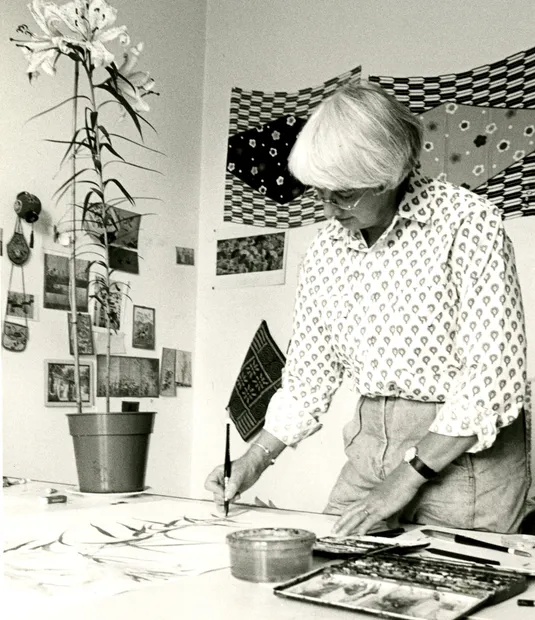
When drawing floral subjects, Blackadder would often place a cut flower onto the paper alongside her sketch, so that she could directly transcribe its likeness. She stated that she wasn’t interested in working with perfect specimens, and instead preferred buds that had not yet fully opened, were blousy and ‘over-bloomed’, or were missing petals or leaves.
£2,800.00 (unframed)
£3,000.00 (framed)
In 1975, Blackadder moved into a house in Edinburgh with a large and well-established garden. Henceforth, cut flowers began to appear in her compositions. She initially depicted them in vases within her still life paintings, but as her interest in the flowers grew, she increasingly portrayed them against a white background, as if they were botanical specimens.
£2,200.00 (unframed)
£2,400.00 (framed)
Blackadder’s floral etchings utilise a process named à la poupée. After etching a composition in outline, colour is applied to the printing plate by dabbing pigment from a little bag, which resembles a rag doll, or ‘poupée’ in French. This technique produces a delightful interplay of sharp fine line and soft, mottled colour.
£1,550.00 (unframed)
£1,700.00 (framed)
Throughout her life Blackadder was a prolific collector. In the 1970s and ‘80s she developed a particular interest in Japanese art and objects, which inspired her first trip to Japan in 1985. She made several visits thereafter, travelling extensively throughout the country. Blackadder documented these experiences through sketches and photographs, many of which she would develop into paintings, drawings and prints upon returning to her Edinburgh studio.
£1,550.00 (unframed)
£1,700.00 (framed)
Blackadder endeavoured to visit numerous gardens during her travels in Japan. This etching likely depicts the Ryoanji Zen Garden in Kyoto, which she first visited in 1985. The rocks are arranged intuitively across meticulously raked sand, which resonated with Blackadder’s own interest in the interrelationship of form and the use of negative space.
£1,550.00 (unframed)
£1,650.00 (framed)
Blackadder recalled that she found Japanese koi fishponds mesmerising, and could watch them for hours. In the 1990s she worked on a series of pictures which sought to express this fascination. They are usually composed as if viewed from above, so that the image surface and the water’s surface appear one and the same. The bird’s-eye perspective also emphasises the fluid forms of the swimming koi.
Royal Scottish Academy of Art & Architecture
The Mound
Edinburgh
EH2 2EL
Monday - Saturday 10am - 5pm
Sunday 12pm - 5pm
This website uses cookies
This site uses cookies to help make it more useful to you. Find out more about cookies.